AgroSense AI is a Sheffy Adey venture applying solar IoT, satellite intelligence, and AI advisory to smallholder farming. The platform is designed to help farmers make better decisions under unpredictable climate conditions by combining low-cost soil sensing, LoRaWAN connectivity, weather and satellite data, and SMS-first advisory delivery.
Smallholder farmers increasingly face unpredictable rainfall, shifting pest cycles, changing planting windows, and pressure to use water and inputs more efficiently. Yet many farming communities still lack access to plot-level intelligence, reliable connectivity, or tools designed for off-grid conditions.
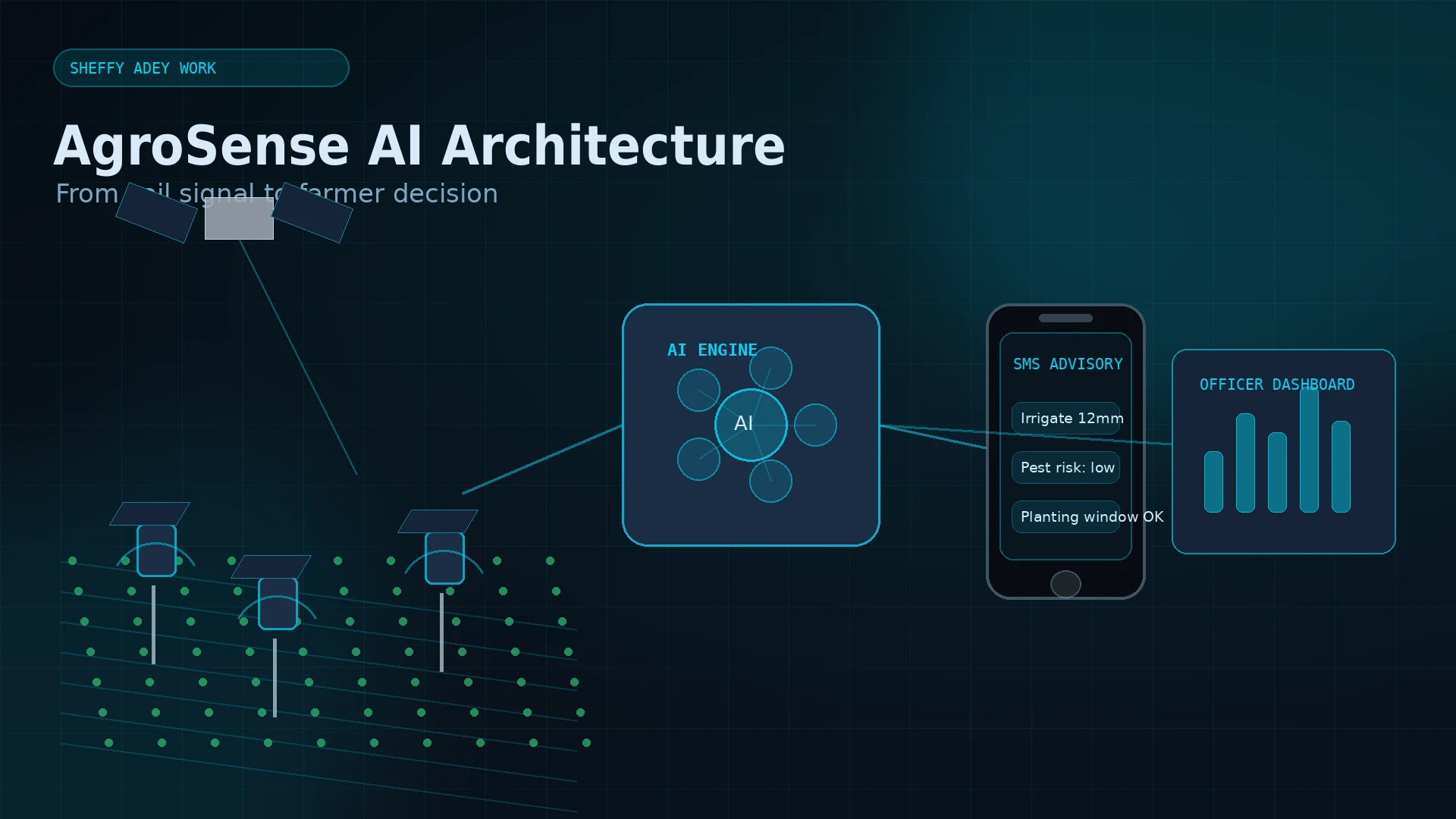
AgroSense AI connects field data to practical daily guidance. Solar-powered soil sensors monitor plot conditions, LoRaWAN networks move data across low-power rural deployments, satellite imagery adds crop and climate context, and AI models translate the signals into simple recommendations for farmers and extension officers.
- Solar soil sensors capture moisture, temperature, and electrical conductivity data.
- LoRaWAN connectivity supports low-power field networking across farmer clusters.
- Satellite and weather data provide broader crop, vegetation, rainfall, and climate-risk context.
- AI advisory models convert the data into crop-specific recommendations.
- Farmers receive simple guidance through SMS/USSD-first delivery.
- Extension officers and agro-dealers can use richer dashboards for cluster monitoring and support.
- Irrigation timing and water-use guidance.
- Pest and disease risk alerts.
- Planting-window support.
- Soil and input-management recommendations.
- Climate-risk monitoring for better planning.
- Field support by extension officers and cooperatives.

A distributed low-power sensor mesh deployed across high-traffic urban zones, producing geofenced air quality events, fleet-level monitoring, and a cloud analytics pipeline — purpose-built for city-scale environmental monitoring without continuous connectivity.
A local authority environmental programme required fine-grained air quality monitoring across high-footfall and high-traffic zones. Existing infrastructure provided city-level averages from a small number of static reference stations — insufficient for identifying pollution hotspots at street level or triggering hyperlocal alerts.
No deployable sensing solution existed at the required density and cost point. Reference station data was too coarse for zone-level decision making. The programme needed a pilot system that could demonstrate street-level resolution, continuous uptime in outdoor conditions, and cloud-connected analytics within a grant milestone window.
- No mains power available at most deployment sites — battery and solar budget critical
- Intermittent LTE coverage in dense urban canyons requiring store-and-forward logic
- Enclosure rated for outdoor exposure including rain, direct sun, and temperature swing
- Grant milestone requiring documented pilot readiness within 6 weeks of build start
- Client team had no embedded engineering capability — full handover required
Full-stack engagement from sensor selection and power budgeting through firmware, cloud pipeline, dashboard, and handover pack. We selected sensor array, wrote firmware with local store-and-forward and OTA update capability, designed the AWS IoT Core telemetry pipeline, and built the Grafana dashboard with geofenced anomaly alerting. Engagement closed with a written handover pack and a recorded operator training session.
- Device layer: ESP32-S3 nodes with PM2.5/PM10, NO₂, O₃, temperature, humidity, and barometric sensors
- Connectivity: MQTT over LTE-M with local 4 MB flash store-and-forward buffer for connectivity drop-out
- Edge logic: On-device threshold detection; geofenced anomaly classification without cloud round-trip
- Cloud pipeline: AWS IoT Core → Lambda → InfluxDB time-series store
- Observability: Grafana dashboard with per-node health, zone-level air quality index, and alert routing
- OTA: AWS IoT Jobs with rollback on failed update — no manual firmware access required
- 99.1% fleet uptime across a 6-week pilot (including 3 connectivity outage events handled by store-and-forward)
- Sub-4-minute alert latency from threshold breach to operator notification
- Zero data loss events during pilot period attributable to system design
- Pilot review passed; phase-two scale plan approved by programme team
Environmental monitoring at street resolution requires hardware designed for long-term unattended operation — not adapted office sensors. This engagement demonstrates capacity to design for real field conditions: power constraints, connectivity dropout, enclosure requirements, and operator handover — not just a connected prototype that works in a controlled setting.
Street-mounted sensor node
Zone AQI + fleet health
Device → pipeline → cloud
An on-device anomaly detection system for rotating industrial equipment — combining vibration and thermal sensing with edge inference to score motor health in real time, trigger operator alerts, and reduce unplanned stoppages without requiring cloud connectivity at the point of detection.
A light manufacturing operation was experiencing recurring unplanned downtime from motor and drivetrain failures. Maintenance was reactive: failures were discovered when equipment stopped, not before. The team had no condition monitoring in place and limited technical resource to deploy or maintain a complex system.
Standard vibration monitoring solutions required network connectivity at the machine level — impractical on the factory floor. Cloud-first approaches introduced unacceptable latency for safety-relevant alerts. The client needed a system that could detect anomalous motor behavior locally and alert operators in near-real-time, with telemetry batched to the cloud for fleet-level trend analysis.
- No reliable Wi-Fi at machine mounting points — inference must run on-device
- Detection latency requirement: under 500ms from anomalous signal to alert trigger
- Model must run within 256 KB RAM and 1 MB flash on target MCU
- No full-time ML engineer on client side — model must be interpretable and maintainable by operations team
- Hazardous area certification requirements for physical enclosure
Sensor selection, enclosure specification, firmware development, edge model design and compression, cloud telemetry pipeline, Grafana dashboard, and full governance pack. We designed a lightweight anomaly scoring model trained on baseline vibration signatures, quantized to INT8 and deployed to the STM32 target. Threshold and alert logic were tuned in close collaboration with the maintenance lead during a 2-week calibration period on live equipment.
- Device layer: STM32F4 MCU with ADXL345 3-axis accelerometer and MLX90614 IR temperature sensor
- Edge inference: TensorFlow Lite Micro — INT8 quantized autoencoder for vibration anomaly scoring
- Alert logic: On-device scoring against configurable threshold; buzzer + indicator LED for immediate operator alert without cloud dependency
- Connectivity: MQTT over Wi-Fi via co-located gateway for batch telemetry and model updates
- Cloud pipeline: Azure IoT Hub → Stream Analytics → TimescaleDB
- Observability: Grafana dashboard showing health score trend, alert history, temperature, and vibration FFT snapshots
- 3 motors flagged by the system and inspected before shutdown during the 6-week pilot period
- 38% reduction in unplanned stoppages compared to equivalent prior period (client-reported)
- Sub-200ms inference latency measured on target hardware under continuous load
- Model false-positive rate calibrated to under 2% during 2-week baseline tuning period
Predictive maintenance in constrained industrial environments requires edge-first inference design — not a cloud model with a local sensor attached. This engagement shows the capacity to design models within MCU memory budgets, tune detection thresholds against real operational signatures, and produce a system that operators can interpret and trust. That combination is what separates a working pilot from a demo.
Motor-mounted enclosure
Grafana trend + alert log
Edge inference → cloud telemetry
A GPS-enabled temperature and humidity monitoring system for pharmaceutical transport, producing tamper-evident excursion records, immutable compliance event logs, and edge-triggered alerts — designed to meet regulatory traceability obligations across a multi-country distribution network.
A pharmaceutical logistics operator needed to demonstrate end-to-end temperature chain integrity across a multi-country distribution network. Regulatory requirements demanded a complete, tamper-evident record of environmental conditions at each stage of transit — from cold store dispatch to final delivery confirmation. Existing paper-based and USB logger processes produced incomplete records and created gaps that triggered compliance queries.
The operator's current monitoring approach failed to produce continuous records during transit. USB loggers were retrieved only on delivery. Excursion events were identified retrospectively, with no location context, making root cause identification and regulatory reporting difficult. The system needed to produce real-time excursion alerts, GPS-correlated records, and a compliance-ready audit trail without relying on uninterrupted internet connectivity across international logistics routes.
- Connectivity unreliable across transit — system must operate fully offline and sync on reconnection
- Device must survive vibration, temperature extremes, and repeated handling cycles
- Excursion records must be tamper-evident and non-repudiable for regulatory submission
- Battery life requirement: 72 hours minimum between charges at continuous logging rate
- Multi-country SIM and network operator dependencies — roaming reliability critical
Hardware specification, firmware development, cloud pipeline design, compliance event schema, dashboard, and handover pack. We specified the nRF9160-based device with multi-band LTE-M/NB-IoT and GNSS, implemented a store-and-forward firmware with local cryptographic signing of excursion events, and designed the Azure IoT Hub pipeline with Power BI compliance reporting. Engagement included a 2-week transit simulation test before deployment across the 4-country pilot network.
- Device layer: nRF9160 SiP with integrated LTE-M/NB-IoT modem and GNSS; SHT40 temperature/humidity; accelerometer for shock logging
- Offline operation: 72-hour local flash logging with HMAC-signed event records; sync on LTE reconnection
- Excursion detection: On-device threshold evaluation; immediate alert queued for transmission at next connectivity window
- Cloud pipeline: LwM2M → Azure IoT Hub → Blob storage for raw records; Azure Functions for excursion event processing
- Compliance reporting: Power BI compliance dashboard with per-shipment excursion log, GPS track, and tamper-evidence verification
- Audit trail: Cryptographically signed event records with timestamp, GPS coordinate, and sensor reading — immutable in Blob storage
- 100% shipment traceability maintained across 4-country pilot — every shipment produced a complete, signed environmental record
- Zero regulatory exceptions raised during the pilot period
- Excursion detection confirmed within 8 minutes of threshold breach during offline transit simulation
- 72-hour battery life verified across repeated transit simulation cycles at −20°C minimum ambient
Cold chain compliance is not solved by connectivity — it is solved by guaranteed local record integrity when connectivity fails. This engagement demonstrates the capacity to design cryptographically sound offline logging, multi-country connectivity handling, and compliance-ready reporting structures that satisfy regulatory reviewers — not just operations teams. The handover documentation was structured to support regulatory submission directly.
Ruggedized transport unit
Power BI shipment + excursion log
Offline signing → cloud audit trail